 Disjoncto


Check and file
RGIE check
After every change, Disjoncto reruns all the rules on the whole project. The result is visible everywhere: at the top of the screen, on the plan, on the board and in the file.
Read this first. The article numbers cited come from Book 1 of the RGIE, version 07 (AREI, the Belgian General Regulations on Electrical Installations). They are a guide; they do not replace the regulatory text. Disjoncto helps you design: the official inspection of the installation is still carried out by an accredited inspection body. The voltage drop and phase balance limits are good practice, not RGIE values.
Statuses#
- Compliant: no blocking remark and no warning.
- n warnings (“To check” status in the project list): at least one warning, no non-compliance.
- n non-compliances: at least one rule not met.
Each remark has a severity, always spelled out in words and accompanied by an icon: Non-compliant, Warning or Info. The status is shown at the top of the editor; tapping it opens the Check tab, whose tab shows the number of remarks.
Remarks#
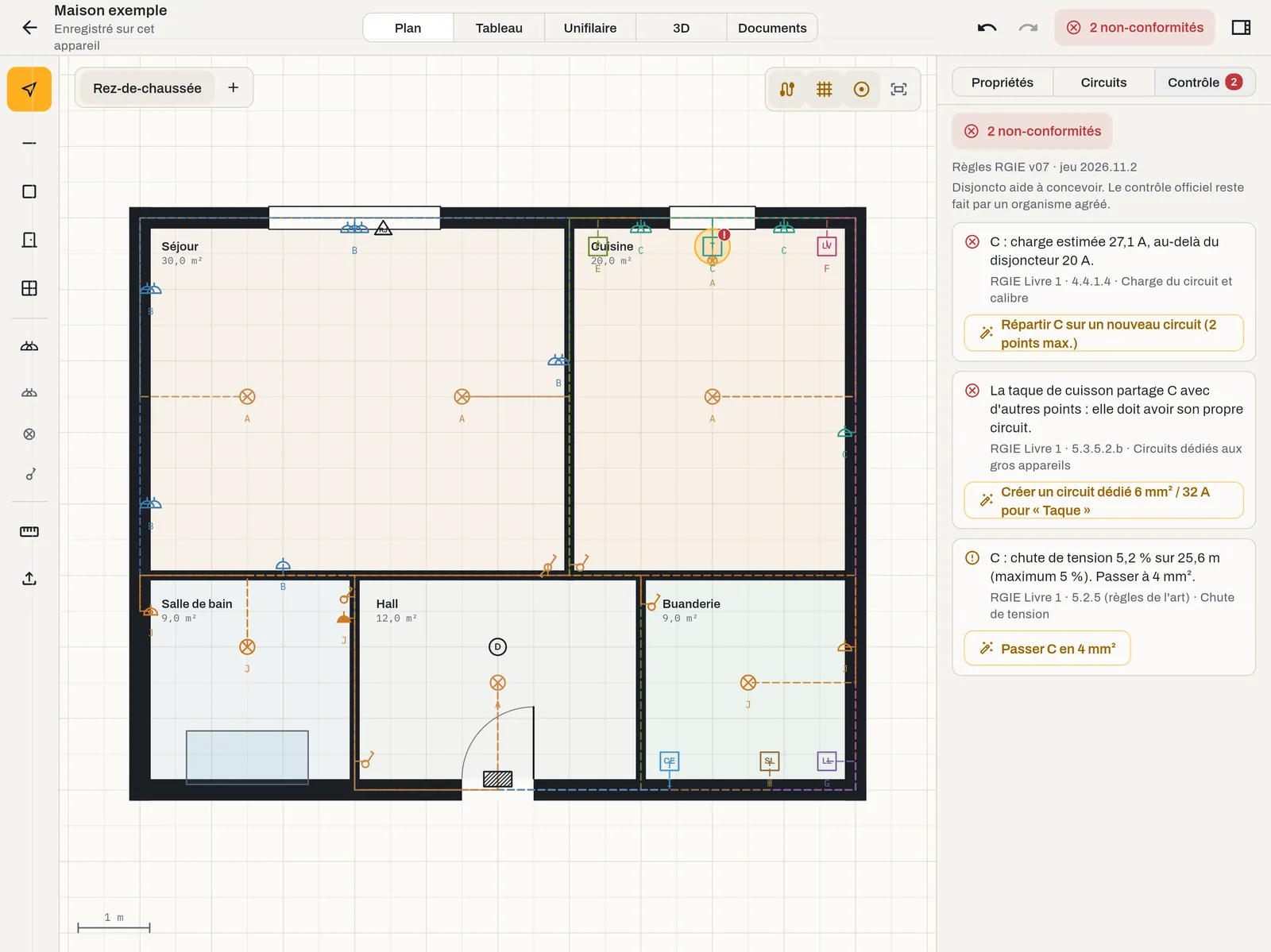
Each remark gives the message (“C: estimated load 27.1 A, above the 20 A circuit breaker”), the article (“RGIE Book 1 · 4.4.1.4 · Circuit load and rating”) and, where possible, one or more fixes. Tap the message to select the points concerned on the plan, on the right level.
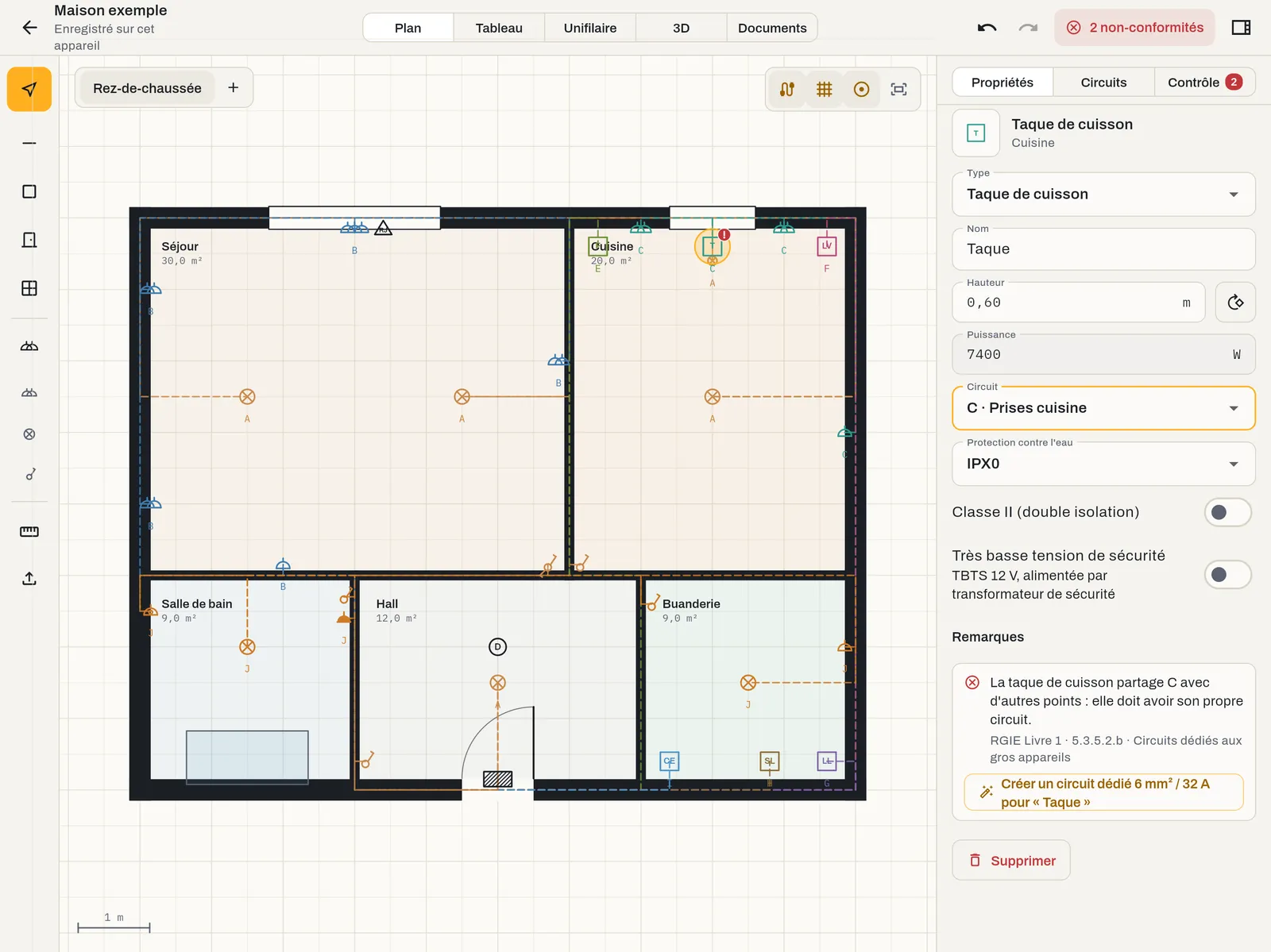
Remarks also appear in the properties of the element concerned, as a red or orange dot on the symbol on the plan, and as an outline on the board modules.
One-click fixes#
The fix button, with its amber outline, describes exactly what it does: “Create a dedicated 6 mm² / 32 A circuit for “Hob””, “Change C to 4 mm²”, “Place A, B behind a 30 mA type A RCD”. It changes the project in a single step; the check reruns.
Undo#
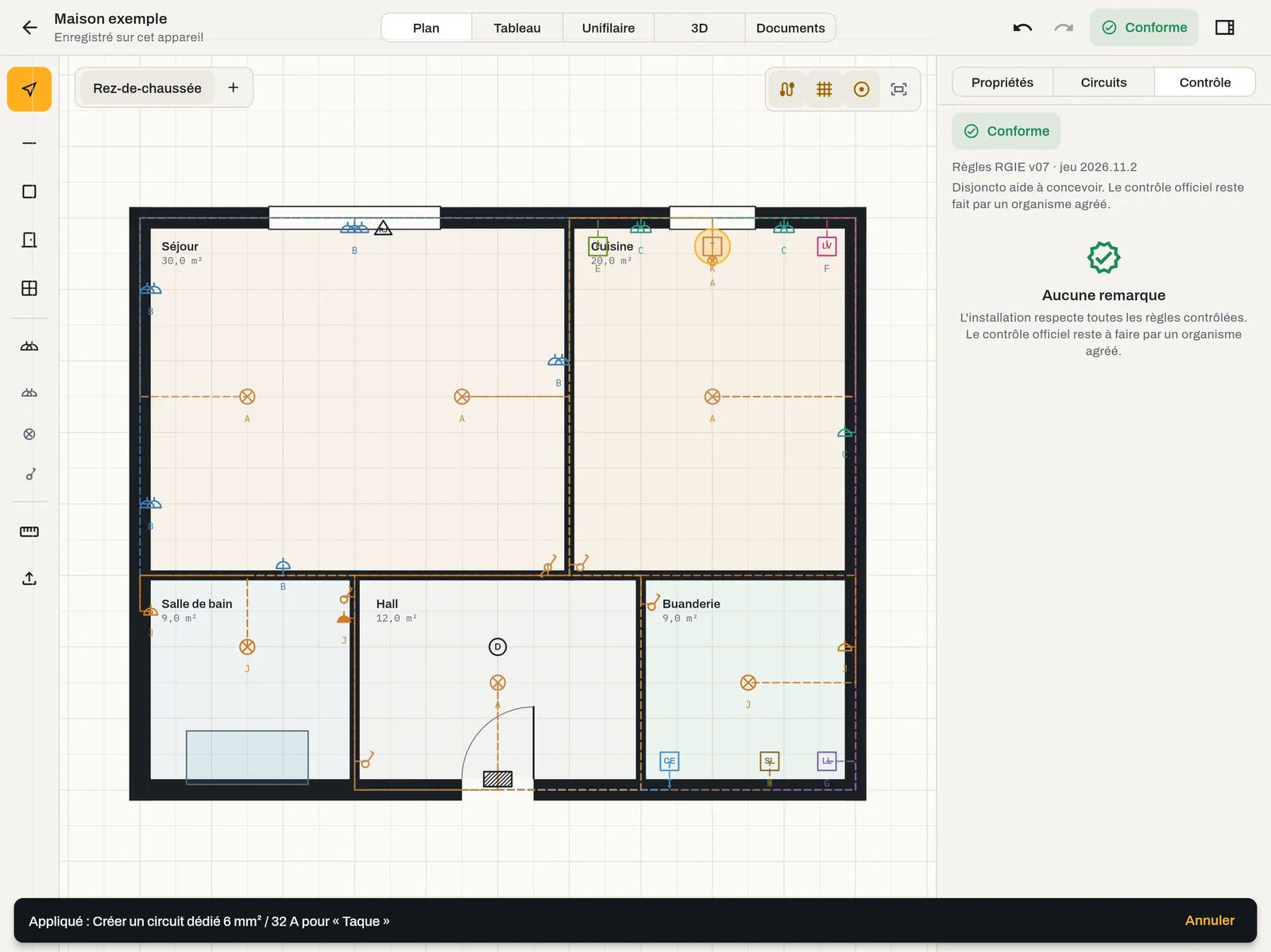
After a fix, the bottom bar confirms “Applied: …” with an Undo button. Each fix is also a step in the history: ⌘ Z or the Undo button in the top bar reverts it, and the tooltip says which action will be undone.
The rules#
Rule set RGIE-07, version 2026.11.2, in force on 1 November 2026, embedded in the application and usable offline. The version in use is shown at the top of the Check tab, in the settings and on the cover of the file. Rule set updates over the Internet are coming soon.
The sixteen rules, in display order, with their default severity:
- Livre 1 · 3.1.2.1.aWarning
Diagrams and plans#
Every point that consumes energy (socket, lighting, fixed appliance) must belong to a circuit. A warning is raised for each point that is not connected to any circuit. No direct fix: run the automatic distribution or choose a circuit in the point's properties.
- Livre 1 · 4.4.1.4Non-compliant
Overcurrent protection#
Every circuit must have its own overcurrent protection: a circuit breaker, or an RCBO. Suggested fix: add a circuit breaker whose rating matches the circuit's cross-section (see the next rule).
- Livre 1 · 4.4.1.4 (tableau 4.11)Non-compliant
Minimum conductor cross-sections#
Minimum conductor cross-section: 1.5 mm² for lighting, 2.5 mm² as soon as a circuit contains a socket or is of the Sockets type. Suggested fix: bring the circuit up to the minimum cross-section.
- Livre 1 · tableau 4.11Non-compliant
Cross-section and rating coordination#
The circuit breaker rating must not exceed what the cross-section can carry:
Cross-section Maximum rating 1.5 mm² 16 A 2.5 mm² 20 A 4 mm² 25 A 6 mm² 40 A 10 mm² 63 A 16 mm² 80 A 25 mm² 100 A 35 mm² 125 A Two fixes are offered: bring the rating down to the maximum allowed, or increase the cross-section.
- Livre 1 · 4.4.1.4Non-compliant
Circuit load and rating#
Compares the circuit's estimated current with the rating of its circuit breaker. Above the rating: non-compliant, with the fix “split onto a new circuit”. Above 80% of the rating: warning.
Estimate: 300 W per socket outlet (a double socket counts 600 W), with a factor of 0.5, unless you have entered a power; appliances at their rated power (hob × 0.7, oven × 0.9); cos φ 0.95 at 230 V.
- Livre 1 · 5.3.5.2.bNon-compliant
Maximum points per circuit#
At most 8 socket points per circuit; a multiple outlet box (double, triple socket) counts as one point and a fixed appliance counts as one point. The v07 rule set sets no maximum for lighting. Beyond two rooms, a single lighting circuit feeding several points is flagged: at least two are needed. Suggested fix: split the circuit onto a new circuit.
- Livre 1 · 5.3.5.2.bNon-compliant
Dedicated circuits for large appliances#
Large appliances get their own circuit, with a minimum cross-section and rating:
Appliance Single-phase Three-phase Hob 6 mm² · 32 A 2.5 mm² · 20 A Oven, washing machine, tumble dryer, dishwasher, water heater 2.5 mm² · 20 A — EV charger 6 mm² · 32 A 6 mm² · 20 A Heat pump, solar inverter 4 mm² · 25 A — Air conditioner 2.5 mm² · 16 A — 32 A socket 6 mm² · 32 A — An appliance that shares its circuit is non-compliant; the fix creates a dedicated circuit with the right values, behind a 30 mA RCD if the appliance requires one. An appliance alone on a circuit whose cross-section is too small gives a warning with the cross-section fix.
- Livre 1 · 4.2.4.3.bNon-compliant
Main residual current device#
Every circuit must sit downstream of an RCD of 300 mA at most, including an RCD at the head of a parent board. Suggested fix: add a 300 mA main RCD to the board.
- Livre 1 · 4.2.4.3.bNon-compliant
Additional 30 mA protection#
Requires an RCD of 30 mA at most for: circuits feeding a point located in a bathroom or shower room, the circuits of the washing machine, tumble dryer, dishwasher and EV charger, all lighting circuits and non-dedicated socket circuits (the 32 A socket is excluded). Suggested fix: place the circuits concerned behind a 30 mA RCD; Disjoncto creates one if none has room. Beyond 8 circuits behind the same 30 mA RCD, a remark is raised (risk of nuisance tripping).
- Livre 1 · 4.2.4.3Non-compliant
RCD type#
Some appliances require an RCD of a given type: type A for the washing machine, tumble dryer, dishwasher, heat pump, air conditioner and solar inverter; type B for the EV charger (flagged as a warning). A higher type is acceptable: B covers F, F covers A, A covers AC. Suggested fixes: change the RCD type, or create a dedicated circuit behind an RCD of the right type.
- Livre 1 · 7.1Non-compliant
Bathrooms and showers: zones#
In rooms of the Bathroom and Shower room types, Disjoncto calculates the zones around the bathtub and the shower: zone 0 inside the fixture, zone 1 above it up to 2.25 m, zone 2 in a 0.60 m band around zone 1, up to 2.25 m. It checks:
- zone 0: safety extra-low voltage (SELV) only;
- sockets prohibited in zones 1 and 2, except SELV; the shaver socket with transformer is allowed in zone 2, not in zone 1;
- switches prohibited in zone 1, except SELV;
- appliances in zone 1: fixed water heater and ventilation only;
- other equipment in the zones: IPX4 at least.
No automatic fix: move the point, or mark it as SELV.
- Livre 1 · 5.2.5 (règles de l'art)Warning
Voltage drop#
Calculates the voltage drop of each circuit over its cable length (routed along the walls or set manually): ΔU = 2 · ρ · L · I · cos φ / S in single-phase, √3 · ρ · L · I · cos φ / S in three-phase, with ρ = 0.0225 Ω·mm²/m. Warning above 3% for lighting and 5% for other circuits; the fix offers the smallest cross-section that stays within the limit.
These limits are good practice, not RGIE values.
- Bonne pratiqueWarning
Phase balance#
In three-phase, and once the total power reaches 3,000 W, compares the load on phases L1, L2 and L3. Beyond 30% imbalance: warning, with the fix “rebalance phases automatically”. Good practice, not an RGIE requirement.
- Règles de l'artWarning
Supply capacity#
Estimates the simultaneous current of the installation (power × 0.5, at 230 V and cos φ 0.95; in three-phase, the most heavily loaded phase) and compares it with the supply rating entered in the level properties. Warning if it exceeds it. Good practice.
- Livre 1 · 4.2.4.3.b / 5.4Non-compliant
Earthing and equipotential bonding#
Checks the earthing data entered in the level properties: earth electrode resistance not entered (warning); resistance above 30 Ω (non-compliant: at least two 30 mA RCDs are then required, with 16 socket outlets at most each, and 100 mA for the other circuits); main equipotential bonding not documented (warning); supplementary equipotential bonding not documented while a wet room exists (warning).
- Bonne pratiqueInfo
Spare room in the board#
Compares the modules in use with the capacity of the enclosure (rows × modules per row). More modules than space: non-compliant. Less than 20% free space: information. Good practice.
What the check does not do#
The check covers what the project contains. It measures nothing on site: insulation, continuity, the actual earth value and the operation of the RCDs still have to be measured and recorded during the accredited body's visit. The RGIE report in the file says so: it prepares the visit, it does not replace it.